
Chapter 31: Comeback
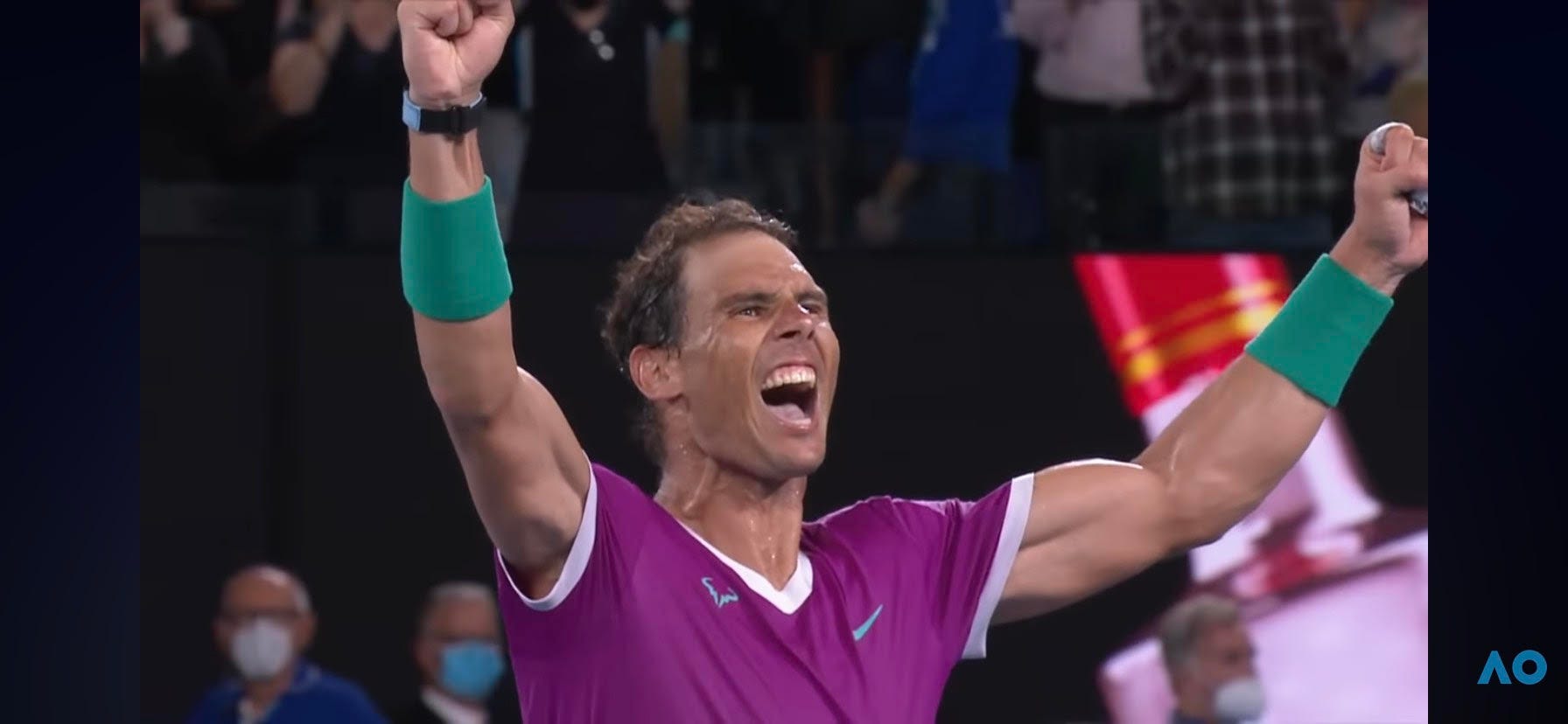
After Djokovic was deported from Australia before the 2022 Australian Open, Nadal pulled off one of his most spectacular feats yet.

In early 2022, Australia required vaccination for entry. Djokovic had been cagey when asked about his vaccination status in press, insisting on his right to keep his medical information private. (To be sure, with respect to an infectious disease, this was an odd stance.) There was much speculation during the offseason over whether Djokovic had gotten the shot or not. He had tested positive for COVID in December. In January, he announced via social media that he was heading to Australia with an “exemption permission.”
What followed was chaotic, to say the least, so much so that when I spent a semester in Melbourne more than a year later, the series of events came up multiple times in my class discussion. A summary after Djokovic flew into the country:
Djokovic was detained at the Melbourne airport due to the Australian Border Force finding his exemption insufficient. Djokovic had previously been granted an exemption by Tennis Australia and by Victoria state government’s health panels. So while Djokovic had been given permission to enter the tournament, he couldn’t enter the country.
Djokovic appealed the decision, spending days in an immigration hotel in the meantime.
A judge ruled for Djokovic’s visa to be reinstated on the grounds of border officials ignoring correct procedure upon his arrival.
In a truly strange scene, Djokovic practiced on Rod Laver Arena with a drone flying above him.
Australia Immigration Minister Alex Hawke canceled Djokovic’s visa again, citing public interest—Djokovic’s presence in the country had been met with some backlash from Australians who had made sacrifices throughout the pandemic. Hawke said that Djokovic could stoke anti-vaccine sentiment in the country if allowed to stay. Though Djokovic’s position was more opposed to mandatory vaccination than vaccination in general, many anti-vaxxers did champion him as a symbol of their beliefs. And in 2020, Djokovic had gone as far as to say “Personally I am opposed to vaccination and I wouldn’t want to be forced by someone to take a vaccine in order to be able to travel,” on a Zoom call with other Serbian athletes.
Djokovic appealed the second visa cancelation, this time to no avail.
Djokovic exited the country and was removed from the Australian Open draw.
Insane, right? There was no doubt Djokovic had been treated unfairly at times; when initially detained at the airport, he was put in a small room, guarded, and had his phone taken. Hawke’s decision also read of a desire to gain political points as much as to improve public safety. But Djokovic’s own culpability was undeniable. He could have avoided the whole mess by simply getting a provenly safe and effective vaccine. The public backlash in Australia, a country that took the pandemic very seriously with strict COVID regulations and high vaccination rates, was unsurprising.
It was Djokovic’s latest act in a long line of self-sabotage, and arguably his most costly yet. Not only was he without the opportunity to win a tenth Australian Open and 21st major title—which he was favored to do, by the way, as he winner of the past three editions of the tournament—he gave Nadal the opportunity to win that long-sought-after second Australian Open title.
Nadal had several issues to deal with: he went into the tournament undercooked after his limited 2021 season (he won a small warm-up event in 2022, but didn’t have to play any top contenders) and was coming off a difficult bout with COVID. His foot had remained an issue throughout 2021. But he was imperious on the court, dismissing Shapovalov and Berrettini en route to the final. Down two sets to a razor-sharp Medvedev in the championship match, Nadal looked toast, but corralled all his will and endurance to put together an astonishing comeback. The match clock read five hours and 24 minutes by the end of the final, the second-longest match of Nadal’s career. It put all those devastating losses at the Australian Open in a brighter, less painful light for him and his fans—he probably should have won the 2012 final in the fifth set, and the 2017 final in the fifth set, and who could forget the sudden back injury in 2014. The 2022 title was a balm on those wounds. And Djokovic’s self-sabotage inarguably weakened his path to that crucial title.
Still, the moment was about Nadal. In a career defined by excelling in the face of adversity, this might have been Rafa’s best-ever comeback. In the third set, serving at 2-3, Nadal fell behind love-30. Then he failed to put away an overhead, letting Medvedev back in the rally, and eventually had to watch a stunning backhand winner down the line fly past. Down two sets and triple break point, though, Nadal’s play one point at a time mentality saved him. Other players would have been discouraged by the finish line standing so hopelessly far away, or made nervous by their precarious position. Nadal stayed calm, set up favorable patterns, and slowly broke Medvedev down. By the middle of the fourth set, Medvedev looked gassed. By early in the fifth, he was approaching to Nadal’s forehand and getting repeatedly burned. Somehow, the 35-year-old Rafa whose body had been through many more trials and tribulations than Medvedev’s, had the greater stamina.
The nerves bit when Nadal served for the match at 5-4 in the fifth; he lost his serve after leading 30-love and Medvedev went up 30-15 at 5-all. Faced with a potentially devastating change in momentum, again Nadal went back to work, one point at a time, and broke right back. At the second time of asking, he served out the match to love.
Again the Djokovic-Nadal rivalry proved unpredictable, even when they weren’t playing each other. Djokovic had dominated 2021, and though he didn’t play the 2022 Australian Open, Rafa had been sidelined for so much of the previous season. If their careers were plotted on a graph, Djokovic’s line was trending upward, hard, while Nadal’s was dropping off. Finally Novak had caught him at 20 major titles. Then, out of nowhere, Nadal pulled off one of the most unlikely victories of his career. It’s one thing to passively say, “never count him out!” and another thing to know why that saying applies so fittingly to Nadal.
The win had been so improbable that before the tournament, I wrote a massive blog post about Nadal under confident assumption that wouldn’t win the Australian Open title. The piece focused on how terrible Nadal’s luck had been at the tournament despite his consistently high level there, and how many of his defining moments came at the Australian Open. And the article resonated with those who read it as much as anything I’ve ever written—which I think suggests that few others gave Nadal a chance, too. Then the guy went out and proved us all wrong.
Thanks so much for reading The Golden Rivalry. Next time: the final (so far, anyway) Djokovic-Nadal match. -Owen