
Chapter 24: Third Man
In 2019, Federer's final push to grab a major title away from Djokovic and Nadal fell ever so slightly short.

With Djokovic struggling after the Australian Open, and considering Rafa’s dominance the prior two clay seasons, Nadal seemed primed to have another monster season on the dirt. But his latest injury, which kept him out of Miami, had knocked him off his game. In Monte-Carlo, he logged three straight-set victories. Then, out of nowhere, Fabio Fognini wrecked him 6-4, 6-2 after Nadal had led 3-1, 15-love in the first set. Fognini put on a ballstriking clinic (he had played doubles with Djokovic in Indian Wells and some speculated that Djokovic had given him some intel on how to play Nadal), but Nadal’s game was oddly toothless. His groundstrokes had no depth or sting. It was like he had briefly reverted to his 2015 self. Djokovic wasn’t doing much better—he lost to Medvedev in three sets, alarmingly hitting more than 50 unforced errors along the way. Were the performances just blips, or had Djokovic and Nadal aged sufficiently that they couldn’t peak at every Masters 1000 anymore?
At least in Djokovic’s case, Madrid indicated that it was the former. He beat Thiem 7-6 (2), 7-6 (4) in the semifinals, a scoreline that belied the intensity of the match. Thiem had been up a break in both sets, but Djokovic refused to give ground at any stage, going right at Thiem’s massive forehand and finding an even greater level in the tiebreaks. He then beat Tsitsipas in the final without facing a break point. Tsitsipas had taken out Nadal in the semifinals, a jarring loss not just because of Nadal’s crushing victory over the young Greek at the Australian Open, but because of the surface on which it happened. We were starting to see the effects of age on Nadal; he couldn’t dominate a clay season start to finish anymore. Injuries took slightly longer to come back from, a brutal match brought with it a worse hangover. He was starting to time his bursts of form right before the majors rather than playing at full burn all the time.
In Rome, with the runway before Roland-Garros running out and concerns about his tennis at fever pitch, Nadal snapped back into form. He took revenge over Tsitsipas with an authoritative 6-4, 6-4 win in the semifinals. Djokovic made the final despite a brutal draw—he ran into a red-hot del Potro in the quarterfinals, having to save a pair of match points just to escape a straight-set loss before emerging 6-4 in the third. Then Diego Schwartzman, a diminutive, plucky Argentine, gave Djokovic hell in the semifinals, prolonging the match to almost three hours before falling 6-3 in the third. It made the final tough to pick—Djokovic would surely be riding a high after demolishing Nadal in Australia, but this was clay, and Nadal would be by far the fresher player. Brad Gilbert, who had coached Andre Agassi and Andy Murray before starting commentary on ESPN, gave Djokovic a 53-47 edge on Twitter.
I remember watching the start of this match on TV. I was convinced Djokovic’s mental edge from Melbourne would prove decisive. Clay or not, it was just hard to imagine Nadal reversing such a one-sided defeat. My stance was vindicated by the Serb’s drop shot winner on the first point of the match. But on point two, Nadal ripped an authoritative forehand down the line—something he had scarcely done (or had the opportunity to do) at the Australian Open—and followed it up with a winner inside-in. Nadal went on to break in the first game, then followed it up with a love hold. It was staggering how in control he looked; the role reversal couldn’t have been more dramatic after that Australian Open final. Down break point again at 0-2, Djokovic hit a few moonballs to push Nadal back. The instant he lofted one with lacking depth, Nadal ran in, feet flickering into place with astonishing speed and remote-control precision, and ripped an inside-in forehand winner. He had an answer for anything Djokovic could and would try.
Nadal won the first set 6-0, the first bagel set of the entire rivalry. That it came directly after the most one-sided loss Nadal had taken to Djokovic in a major was fitting. That defeat was as demoralizing as defeats could get. It was brutal. Third set of the 2012 Australian Open final stuff. Yet here came Nadal, smothering Djokovic like a tidal wave, completely impervious to the scar tissue of previous matches. As just the second Djokovic-Nadal match I had watched live, the potential places the rivalry could go were enchanting to think about. Each player was capable of godlike levels of play on their respective favorite surface, a level that could render anyone else completely helpless. Literally anything seemed possible on any given day when the two titans played.
Djokovic made an admirable push in the second set, saving three break points at 3-all and another at 4-all before breaking for the first time to take the stanza 6-4. It still wasn’t enough to deny a determined Nadal, who played a furious third set, breaking Djokovic three times to seal the match 6-1 in the decider. The Spaniard had reaffirmed his status as favorite ahead of Roland-Garros yet again, Djokovic right behind.
Both men advanced to the semifinals in Paris without much difficulty, but in the last four, Djokovic put in a disappointing performance against Thiem. In intensely swirling winds, he played almost listlessly in the first set and lost it 6-2. He managed to even the match before the weather forced the match to resume the following day. Thiem was the slightly stronger on day two, clocking 7-5 wins in the third and fifth sets. Djokovic was fully engaged here, saving a pair of match points down 3-5 in the fifth set, but Thiem was too powerful, slamming home a forehand winner at 93 mph to advance to the final. Though Djokovic had competed commendably for much of the match, the first set was hard to ignore. Not only that, he came to net an incredible (and bizarre) 62 times, winning just 32 of those points. The strategy was somewhat inexplicable; Djokovic hadn’t lost at a major in 12 months, yet elected to live and die by kamikaze net rushes on the slowest surface. And this from a man who had built his empire on baseline dominance. Djokovic did not need to win Roland-Garros, having claimed the previous three major titles, but the loss was an odd way for his 26-match winning streak at the majors to end.
Nadal, predictably, waxed Federer in an equally wind-stricken semifinal, 6-3, 6-4, 6-2. Early in the third set, he’d chased down a Federer backhand hit at an acute angle that beggared belief, cut a deep, sliced forehand return from miles outside the doubles alley, then recovered his court position and eventually banged a crosscourt backhand winner. He might not have had the foot speed he had at the beginning of the decade, but still had more than enough magic to produce moments like that.
Thiem put up a brave front in the final, playing Nadal on level terms through an opening seven games of supreme quality and even winning the second set 7-5. From there, though, Nadal’s all-time-great tennis on the Parisian dirt proved way too big an obstacle, seeing him storm through the final two sets with identical 6-1 scores. Thiem had played on four consecutive days before the final, which couldn’t have helped his cause, but Nadal’s tennis was as startlingly incisive as ever. Unlike Djokovic in the semifinal, Rafa made his net rushes count, hitting stunning volleys on the stretch as well as his usual reliable putaway volleys. His dominance at Roland-Garros looked, as had become custom, sustainable.
Wimbledon in 2019 was, in many ways, an inflection point of the Big Three era. Going in, Djokovic had 15 majors, Nadal 18, and Federer 20. The Serb and the Spaniard, having shared the previous five major titles, looked intent on running Federer down. Federer hadn’t been able to keep pace with his rivals in the previous year and a half, but Wimbledon, where he was an eight-time champion, represented what was likely the best possible chance for the Swiss to add to his lead. If Djokovic won it, he’d maintain the furious major-winning pace he had set in late 2018. If Nadal won it, he’d be just one major away from Federer. The stakes were high.
Fittingly, each titan cruised to the semifinals. (The fourth man was 23rd seed Roberto Bautista Agut, reaffirming that the aging Big Three had no consistently threatening challengers.) Djokovic took out Bautista Agut in four sets, priming himself to play the winner of Federer-Nadal. At the time, I was convinced the Spaniard would win—he’d destroyed Federer at Roland-Garros, he’d won a major more recently, he’d even been better at Wimbledon the previous year—but Federer put on a masterclass to seal a four-set win. Nadal was unable to find his best tennis save for a few patches over the course of the match, but Federer’s sharp backhands, precise serving, and lethal forehands made things extremely difficult. The win was one of the best of Federer’s career. When trying to serve out the match, he survived a biffed overhead at 30-all and two exceptional match point saves from Nadal—an inside-out forehand winner after a 24-shot rally and a crosscourt backhand pass—to get over the line.
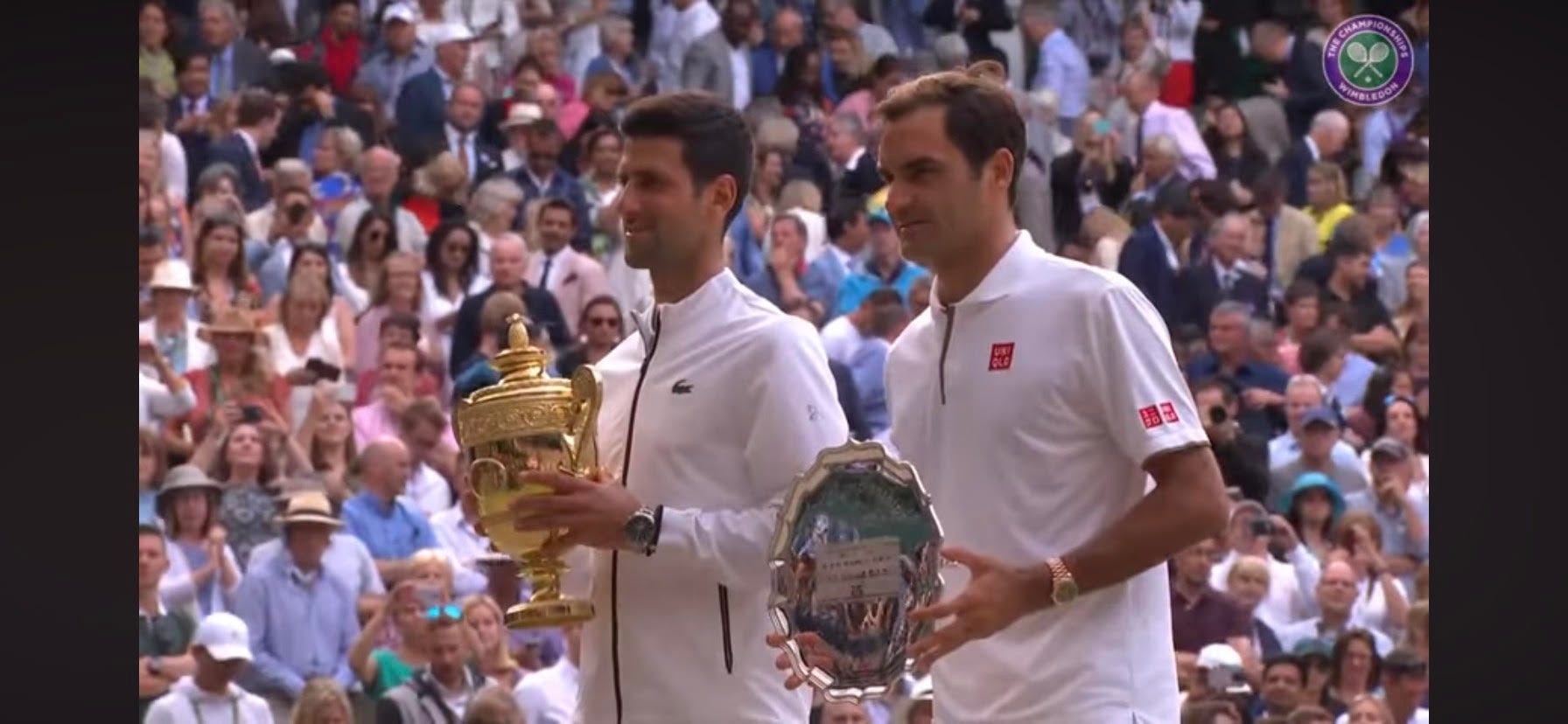
A neutral observer would have expected Djokovic to be very confident ahead of the final. He hadn’t lost to Federer in a major since 2012, and while that had been at Wimbledon, the Serb had beaten Federer in the 2014 and 2015 finals at the same tournament. At the time, I was a rabid Federer fan and struggled to envision ways that he could win, though I desperately wanted him to. Yet Djokovic’s performance in this major final was among his worst. I couldn’t watch the match live, studying Spanish at a running and community service camp in Peru at the time, but I still remember the moment when I knew this match was different from their previous Wimbledon finals. I asked my counselor for a score update.
“First set, siete-seis, Djokovic,” he said. Expected. Federer and Djokovic had played four tiebreaks in their two Wimbledon finals.
Then: “Second set: seis-uno, Federer.” This had never happened before, not in a major final. Even going back to 2007, when Federer won sets against Djokovic in major finals, it was always by the skin of his teeth. I knew something had to be wrong with Djokovic, and that meant Federer had a chance.
My spirits dipped again when I saw that Djokovic had won the third set in another tiebreak, but a closer look at the live score told me that Novak, the best returner of all time, was yet to produce a single break point. Though Federer had never beaten Djokovic from two sets to one down before, I maintained hope that he could win here as the Google score ticked from 4-2 Federer to 5-2 Federer in the fourth set. At 7-7 in the fifth set, I was back in front of a cracked phone screen to follow the score.
I was shaking as Federer broke for 8-7. Love-15. 15-all. 30-15. 40-15. Holy shit, he was going to do it.
We all know what happened next. Federer blew a forehand and Djokovic nailed one of the most important ones of his life, again hitting the crosscourt pass to perfection in one of the biggest matches possible. A big inside-in forehand from Djokovic and another errant forehand from Federer later, it was 8-all in the fifth.
Watching the live score, I didn’t see these shots as they happened. But I do remember how I felt at the time—my heart sunk, of course, but I had also lost hope that Federer could win. I knew he wasn’t going to get a better chance than the one he’d just had. I knew that Djokovic wasn’t going to give him that chance, no matter what Federer did. That was it. (When I could view the match more objectively later on, I was more proud of Federer for battling his way to break points at 11-all in the fifth after missing those match points than anything else he did all match.)
Reading about the final later only twisted the knife. Federer had been up 5-3 in the first set tiebreak. (Cue my wince.) Federer had a set point in the third set. (Cue a bigger wince.) Federer had the better-looking stats in every single metric besides unforced errors and match points converted. (Cue my blank stare into space as I wondered how long it would take before I could feel joy again.)
But what better way for Djokovic to demonstrate his superhuman abilities under pressure? This was his finest contortionist act—Federer’s game was firing on all cylinders while his own was failing him more than he had been conditioned to expect. Something like 98% of the crowd was screaming desperately for Federer to win. Djokovic seemed fated to lose this match and he found a way to win it.
Much was on the line. Djokovic had been open about his goal to chase down the major titles record. He was closing the gap with Federer, but if the Swiss won Wimbledon to seal #21, Djokovic would have to win 22 to achieve his goal. The potential swing was massive—Djokovic could cut the gap to four major titles by winning the final. These numbers may well have flashed through Djokovic’s head earlier in the match as Federer put together a fantastic performance, swiping aces and slicing delicate volleys that swan-dove on the grass.
As far as major titles were concerned, it was the end of Federer’s career. He would never win another, while Djokovic and Nadal shared nine of the next 11. Such is the brutality of playing in an era with rivals like them.
Thanks so much for reading The Golden Rivalry. (Though I suppose that with the focus on the 2019 Wimbledon final in this edition, this was more like The Silver Rivalry. Or bronze, depending on your point of view—I think Djokovic-Federer is the third-best of the Big Three duels when they’re all firing, but is probably more consistently good than Federer-Nadal.)
Sorry for the break. Like I mentioned in the previous chapter, I was staying with a friend last weekend and missed the Sunday slot, then for some reason skipped Wednesday altogether. I’m at the point in this book-writing process that Nadal is at in his career right now. Not to worry, though—in Rafa fashion, I’ll keep pumping out these chapters until there aren’t any left. See you Wednesday!
It always amazed me how Federer nailed his first serve ace to get to 2 match points, but once there, he forgot how to ace Djokovic entirely.
Great installment Owen. Would you consider publishing it as a book?