
Chapter 30: Separation
In 2021, Novak Djokovic's GOAT case started to creep ahead of his rivals'.

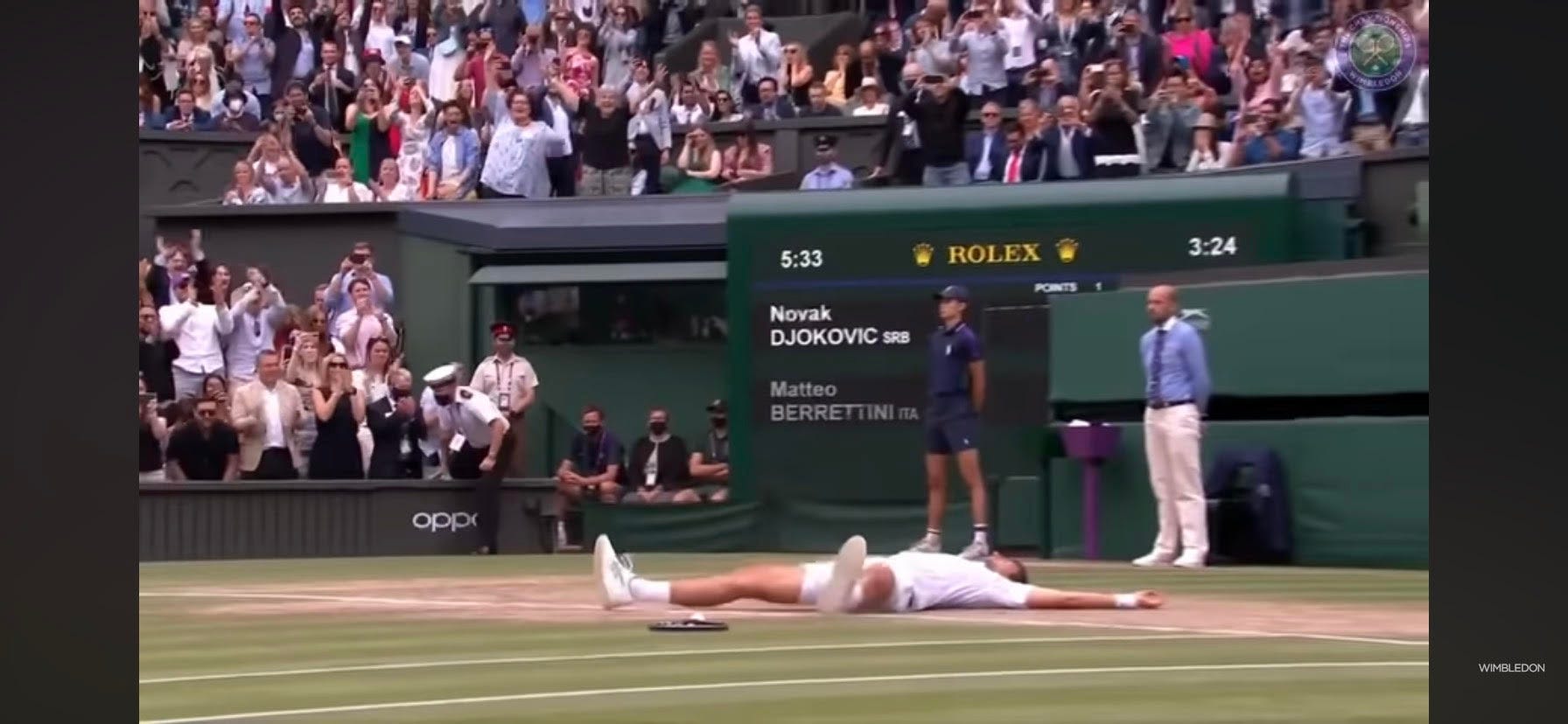
The Roland-Garros semifinal was a turning point for both players in 2021. Nadal would only play two more matches in the season, sidelined by his increasingly aggravated foot. (Making it all the more incredible he had played as well as he did in the loss to Djokovic.) The Serb, meanwhile, continued to surge. His GOAT case was stronger than ever after Paris, and he added another feather in his cap by winning Wimbledon for his first Channel Double, his 20th major title, and his sixth Wimbledon. It tied him with Federer and Nadal in major titles, but at this point, it felt like he was considerably ahead of them both.
Djokovic was barely pushed in winning Wimbledon. Matteo Berrettini put up a good fight in the final, winning the first set in a tiebreak. Djokovic didn’t let him get any further, surrendering his serve just once over the next three sets. In the semifinals, Denis Shapovalov made Djokovic work in all three sets, but lost them all. With Nadal fading into the background with injury, there was no one to challenge Djokovic. Federer had ruined his knee and lost to Hubert Hurkacz in the quarterfinals, which would spell the beginning of the end of his career. Djokovic, younger and stronger, had outlasted his rivals.
Talk immediately turned to Djokovic winning the Calendar Grand Slam. What better way to unilaterally take over the men’s major title record and seal his legacy as the greatest ever? In retrospect, the pressure was unfair; Djokovic had already had a monstrous year. Roland-Garros had been the meaningful title, punctuated with that semifinal win over Nadal. Yet instead of celebrating that achievement, viewers quickly moved on to projecting Djokovic to do something that had not been done on the ATP since Rod Laver in 1969.
Djokovic made an incredible run at the feat, advancing all the way to the U.S. Open final. But it had taken too much out of him to get there—four brutal sets against Kei Nishikori, Matteo Berrettini, and Jenson Brooksby; five exhausting sets against Zverev in the semifinals. Djokovic was mentally and physically wasted in the final and Medvedev beat him by the anticlimactic scoreline of 6-4, 6-4, 6-4. The near miss was brutal. Djokovic cried before the last game of the match as the U.S. Open crowd, historically loath to warm to him, showered him with cheers on the changeover. After the match, he said he was glad for the quest to be over. If that doesn’t show the nauseatingly high pressure of coming close to the calendar Grand Slam, I don’t know what does. Some situations are too difficult even for the best players ever.
Even so, Djokovic’s 2021 was a coronation of sorts. He had tied Federer and Nadal in major titles and looked certain to exceed them in 2022. He had his Double Career Grand Slam. At Roland-Garros, Nadal had arguably his best chance yet to even the head-to-head since Djokovic had taken the lead, given they were playing on his favorite court, yet Djokovic denied him to go up 30-28. (Pause for a second to appreciate that someone has beaten Rafael Nadal 30 times.) He was, most agreed, the greatest of all time. And there was surely more to come.
By the middle of the following year, Djokovic’s dominance felt like a distant memory.
Thanks so much for reading The Golden Rivalry. Not far to go before the end! See you Wednesday. -Owen
Love this