
Chapter 28: Return
In the 2021 Italian Open, Djokovic and Nadal reverted to form following a difficult clay season for both.

The 2021 clay season began oddly. In Monte-Carlo, Djokovic lost to Dan Evans and Nadal lost to Andrey Rublev. The losses weren’t worrying for the future, there was plenty of time before Roland-Garros, but the nature of the defeats was potentially concerning. Djokovic had been abysmal in his loss, making error after error en route to a straight-set exodus. Nadal was also deeply off, frequently berating himself after misses. After losing the opener, he managed to steal the second set after saving break points to avoid a double break deficit. That should have been his spark to roll through the third, but instead he found himself embroiled in the bad form of the first set again. The scoreline 6-2, 4-6, 6-2 reflected the degree to which Nadal was struggling with his game.
Madrid did little to restore normalcy. Djokovic skipped it to play his home tournament in Belgrade; Nadal fell to Zverev after consistently failing to put away short forehands, a task he had so mastered over the course of his career. The youngsters were starting to pick off the Masters 1000 tournaments, which Djokovic and Nadal could no longer lock up with the ruthless reliability of their younger years.
Rome, though, served as the reset button yet again. Nadal and Djokovic each had to fight through dangerous matches—Nadal saved two match points to beat Denis Shapovalov; Djokovic escaped a series of near-fatal deficits against Tsitsipas, who had won Monte-Carlo—to make the final. But make the final they did, setting their first meeting of 2021.
Appreciation for the matchup was growing. The Djokovic-Nadal rivalry had been burning for 15 years by now. Federer had barely played in the previous year and a half, a knee injury he sustained at the 2020 Australian Open keeping him sidelined, and hadn’t played either of his rivals for over 12 months. Nadal and Djokovic were managing their physical declines calculatedly. They could play terribly in a tournament, then turn around and win a major the next week. Faced with aging bodies, they fell back to defend the majors, the most prized titles on tour. Their intensity could flicker over the course of a match, but on that break point in the deciding set, they would unfailingly come up with the goods.
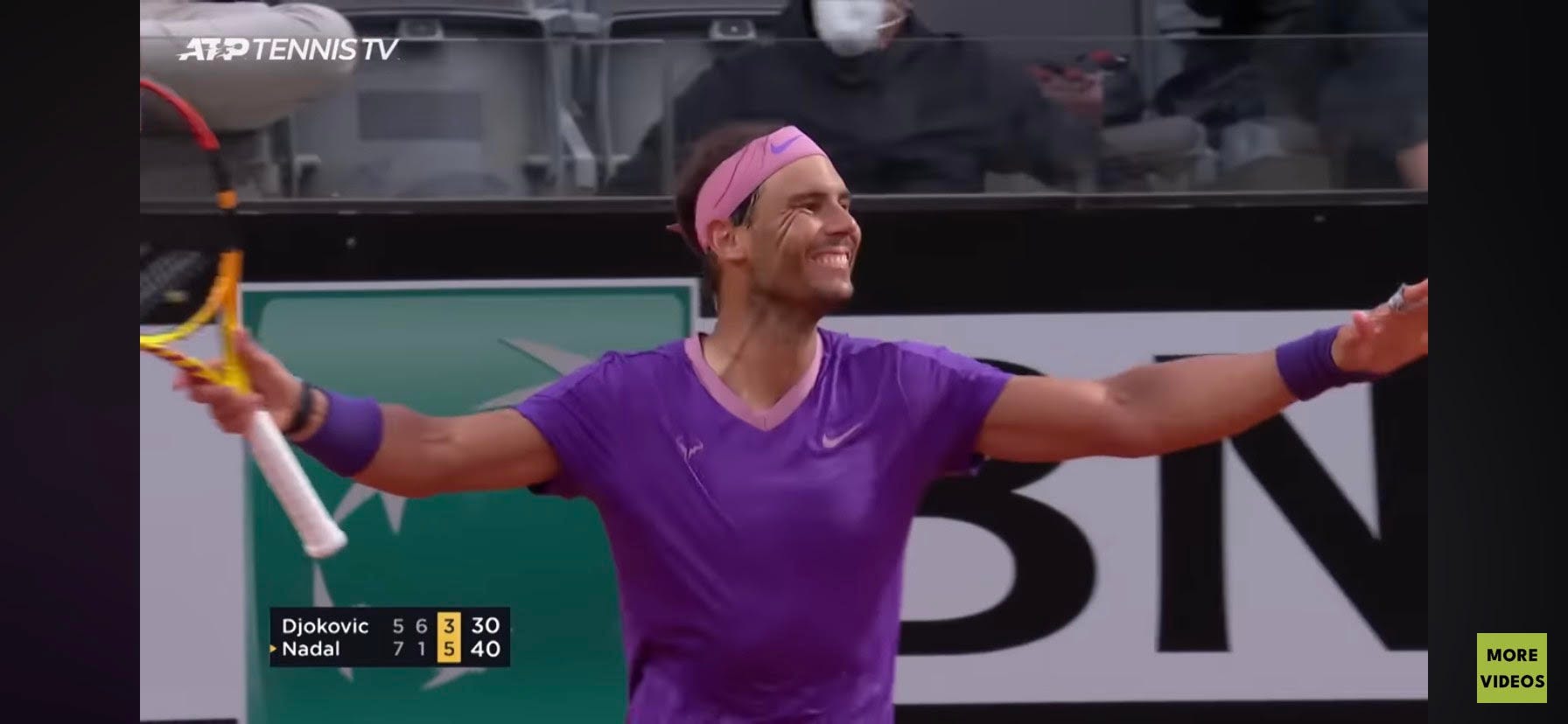
The Rome final only reinforced admiration for the two legends. (I recapped it game-by-game on my tennis blog at the time.) Nadal was expected to win fairly comfortably, having lost just one set in his last three matches against Djokovic on clay, but the Serb joined the battle quickly and eagerly. He ripped a backhand winner down the line on the first point. At 0-1, 30-15 on Nadal’s serve, Djokovic anticipated an inside-out forehand putaway from Nadal, sliding into a volley to pass Nadal through the open ad court. The first set was wonderful, featuring the classic push-pull of the rivalry from start to finish. Djokovic executed a serve-and-volley play well, dropping the volley short; Nadal chased it down and passed him anyway. Djokovic was down break point; he answered with consecutive backhand winners down the line. Nadal was down 15-30 as he served to stay in the set; he hit three winners in a row to get to 5-all.
At the end of the set, as expected, Nadal was slightly sharper. At 5-all, 40-30, Djokovic double faulted. Nadal immediately pounced, firing a deadly forehand winner down the line on the following point. The Spaniard served out the set 7-5 from love-30 down, clocking a fierce inside-out forehand to seal it. Nadal had struck 15 forehand winners in the first set; his greatest weapon, always a menace, had been refined into the most incisive stroke possible. Even with Nadal well past his best years, his forehand could take over a match, even if nearly everything else was faltering.
Djokovic steeled himself in the second set. He survived a couple early holes on serve, then began attacking Nadal’s backhand corner. He sent every shot possible to that side of the court, intent on pushing Nadal back or producing a weak ball he could batter away. The Serb executed the tactic exceptionally in the second set. An unexpected Nadal lapse contributed to the thumping 6-1 scoreline, but Djokovic had been fabulous. On set point, he varied his spins and pace of shot to keep Nadal off-balance, eventually forcing an error with an angled forehand crosscourt.
Djokovic continued to clamp down in the third set. At 2-all on Nadal’s serve, he produced two break points which, given that Nadal hadn’t broken serve since the first set, could have been decisive. He attacked on the first, forcing the Spaniard to play great defense to stay in the rally. Djokovic advanced on a hanging ball in the middle of the court that wasn’t quite a putaway but wasn’t far from it and netted an aggressive forehand. Nadal erased the second break point with a backhand winner down the line. He closed out the game with a brutal forehand that Djokovic could barely get a racket on. The Spaniard celebrated effusively, well aware of the momentum swing that had just occurred.
From 3-2 to the finish line, Nadal was unstoppable. He promptly broke Djokovic at love, hitting three winners in the game (one clipped the net cord on its way past Djokovic, another resulted from Djokovic clipping the net, producing a sitter). He held at 15 with a clean forehand passing shot. Djokovic saved a championship point at 2-5, but Nadal duly served out the match. The passage of play was a clear reminder that he was still the best on clay, that his A game could render anyone else helpless for games on end. He was, as always, the favorite to win Roland-Garros.
Djokovic took the loss gracefully. He joked about the NextGen—the moniker given to the young future starts of the ATP—in his runner-up speech, saying that he, Nadal, and maybe Federer were the NextGen despite their increasingly advanced ages. The thing was, he wasn’t totally wrong. Djokovic was indeed the last young ATP player to take over the tour. It had happened way back in 2011 and he remained the best player in the world. Nadal, who had won his first major in 2005, was still casually crushing skulls on clay. Dozens of young challengers, many of them expected to inherit the keys to the ATP, had broken themselves on the impregnable walls that were Nadal and Djokovic. To the Serb, maybe the NextGen was just the latest crop of young aspirations he had to stifle rather than a death knell for his days at the top.
Thanks so much for reading The Golden Rivalry. Next time: the 2021 Roland-Garros semifinal! Hope you’re all doing well. -Owen