
Chapter 25: Roger Federer
Though Federer had a losing head-to-head against both Djokovic and Nadal, his impact on their careers can't be understated.

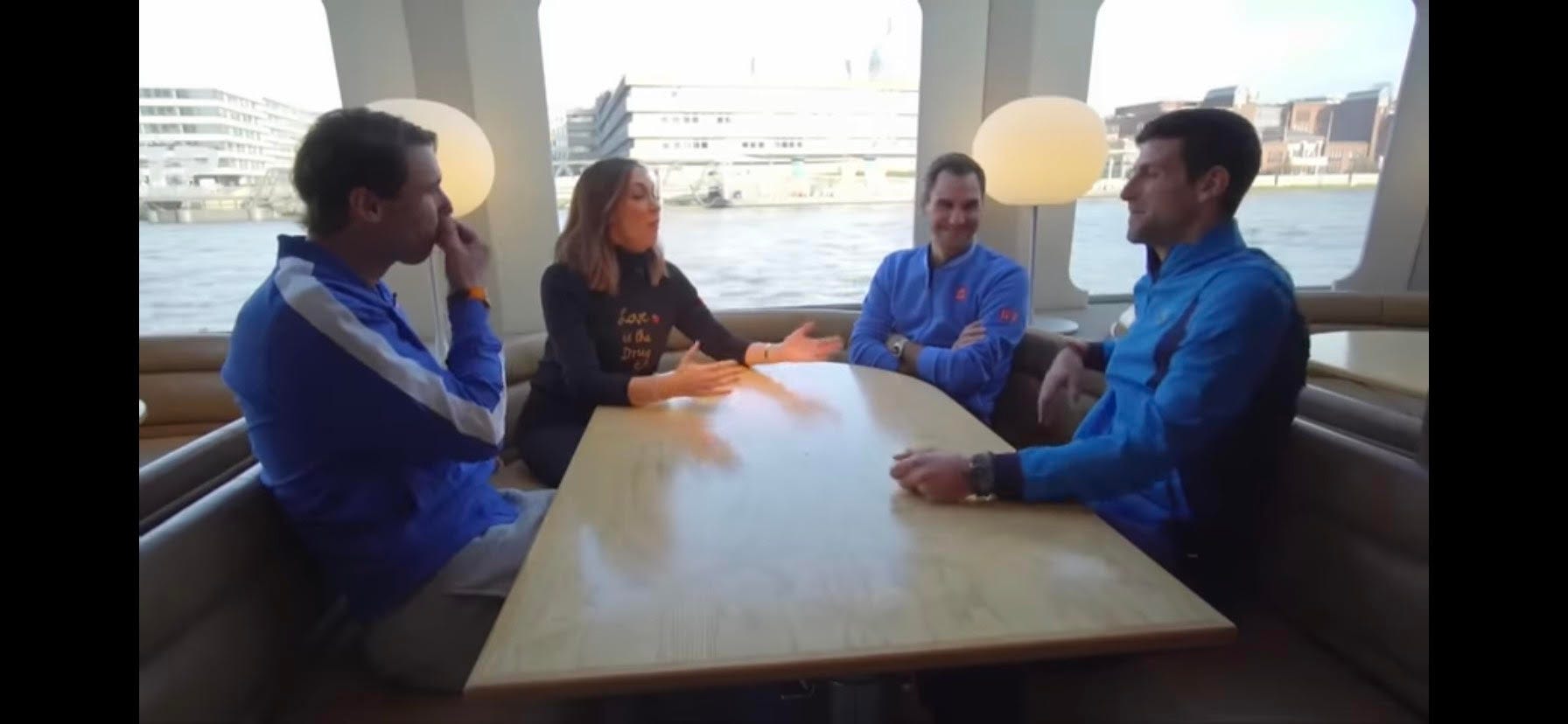
For years, Roger Federer was widely considered the greatest male player of all time. Nadal wasn’t seen as a serious threat to his major titles count until 2013, Djokovic until 2018 or 2019. His place in the Djokovic-Nadal story is difficult to precisely pin down. Legacy-wise, he spent the bulk of his career ahead of both, until his rivals exceeded his 20 majors in 2022: Nadal at the Australian Open and Djokovic at Wimbledon. Rivalry-wise, he trails in both head-to-heads. He’s never been ahead of Nadal—despite making a late break to win six out of their last seven matches, the Spaniard won that rivalry 24-16. Federer once had a convincing 13-6 head-to-head against Djokovic, though he’s lost 21 of the last 31 matches for the current and final tally of 23-27.
Despite the unfavorable numbers, Federer has played a huge role in the development of Djokovic and Nadal, and the entire era by extension. He was the first man to reach outlandish levels of dominance, winning 14 of 24 majors in the stretch from 2004 to 2009. Without Federer to chase, it’s likely Nadal never would have improved his game to the extent he did, tailoring it to be more effective on the faster surfaces. While Nadal was the one who showed Djokovic the physical and mental standard he needed to reach, it was being fed up with constantly losing to Federer at the U.S. Open that led to Djokovic’s immediate breakthrough in 2010.
Federer had the biggest serve of the three, a laser-guided stroke that pierced the corners of the service boxes. You had to be a world-class returner to stand a chance against it. Federer had the most powerful groundstroke of the three in his easy-power-loaded forehand. You had to be an astonishing defender to keep the ball in play. If Federer had a weakness, it was in his topspin backhand and passive second serve returns. You had to pounce on those returns with no hesitation, break down that backhand mercilessly. Of course, Djokovic and Nadal did all those things, but it’s unlikely that without a fierce measuring stick in Federer, they would have reached such an unprecedentedly high level of execution. Is Djokovic compelled to become the greatest returner in history if a massive rival is one of the greatest servers? Would Nadal have become the speed demon he was if he were chasing down forehands lesser than Federer’s? Maybe not.
You can argue that Djokovic and Nadal were inevitable, that they would push each other to do everything Federer pushed them to do, but it’s important to remember they went up against Federer for years before they started to play each other in earnest in the late 2000s. The early matches with the Swiss were invaluable experience for both Nadal and Djokovic. The latter, after losses, would say that while Federer was the best, he felt the Swiss was within reach, that he was beatable. That anything-is-possible attitude would prove crucial in the years to come. For Nadal, chasing after Federer at Wimbledon and in the rankings for years on end—and eventually getting past him—surely played into his aura and formidable resilience. The success may well have helped him stay with Djokovic after 2011. He had taken down a rival who was above him before; he knew he could do it again.
Not only was he the standard for so many years, but Federer also scored some incredible wins against Djokovic and Nadal. In 2015, the Serb’s best-ever season, Federer beat him three times, all in straight sets. He snapped Djokovic’s astonishing 2011 winning streak with a peak performance in the Roland-Garros semifinals. After years of torment at Nadal’s hands, Federer showed the necessary humility and tactical acumen to modify his backhand, taking it earlier and harder. That shot carried him to two monumental wins against Nadal, the 2017 Australian Open final and the 2019 Wimbledon semifinal.
All that said, Federer was comprehensively surpassed in the end. The breakdown of his matches against Djokovic and Nadal in majors versus other players is a good illustration of his struggles—in major finals, he is 4-10 against his rivals and 16-1 against everyone else. Nadal and Djokovic don’t just have more major titles, they’ve won more of them by going through a fellow member of the Big Three. Federer’s 20 majors include seven wins over Djokovic or Nadal; Nadal’s 22 majors include 14 wins over Djokovic or Federer; Djokovic’s 24 majors include 13 wins over Federer or Nadal. Though Federer still had the endurance (see Wimbledon 2019) and the skills (see Australian Open 2017/2018 and Wimbledon 2017) to win majors in his older days, it happened “just” five times after 2009, and that’s down to his rivals hitting their peaks in the interim. All told, Federer is a combined 10-21 against Djokovic and Nadal in majors. The great Swiss was the glorious target all others sought to hit for a long time, but once his rivals locked onto it, they didn’t let their sights wander.
Djokovic and Nadal mastered every part of the game Federer was slightly lacking in. They became incredible returners of serve. They played practically every big point on their own terms. They were aggressive baseliners, but were more patient than Federer, content to work a point for 20 or 30 shots if necessary. Federer was an all-time-great defender, but somehow, Djokovic and Nadal were better. The Spaniard was a revolution in foot speed, Djokovic a marvel in sliding on all the surfaces. Through a commitment to chase each other (and anyone else who dared rise to prominence) down to the depths of hell and beyond, they surpassed all who had gone before on the ATP.
Thanks so much for reading The Golden Rivalry. This has now been two chapters in a row that have heavily featured Federer—let it never be said that I don’t pander to all fanbases. On Sunday, we’ll be back to more Djokodal matches. See you then! -Owen
I wonder if Roger Federer, as great as he is, already knew in the early 2010s that both of them will surpass him down the road. It would have taken immense grit and determination to then still work on, improve and try to fight a losing battle, just for the love of the game.
And you are right, if Federer never happened to do what he did, I don't think Nadal would ever win a slam outside of clay and Djokovic would be rolled once he won a few.
I still think Federer's tears in 2009 were, at least sub-consciously, because he knew deep inside that his era of dominance is coming to it's end. I maintain his 2017 surge was one of the most impressive things I've seen in tennis - considering Fed was the most reticent to change out of the Big 3, and how specific his game is (and how glaring it's faults are to the other two).